

How Peak Roaming Bill Shocks of $1.5B Forced Digital Nomads to Abandon Primary Carriers (2026 Guides)
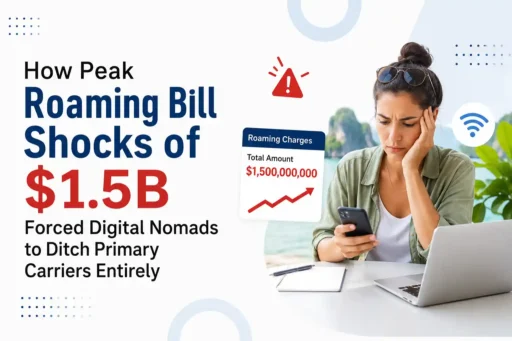
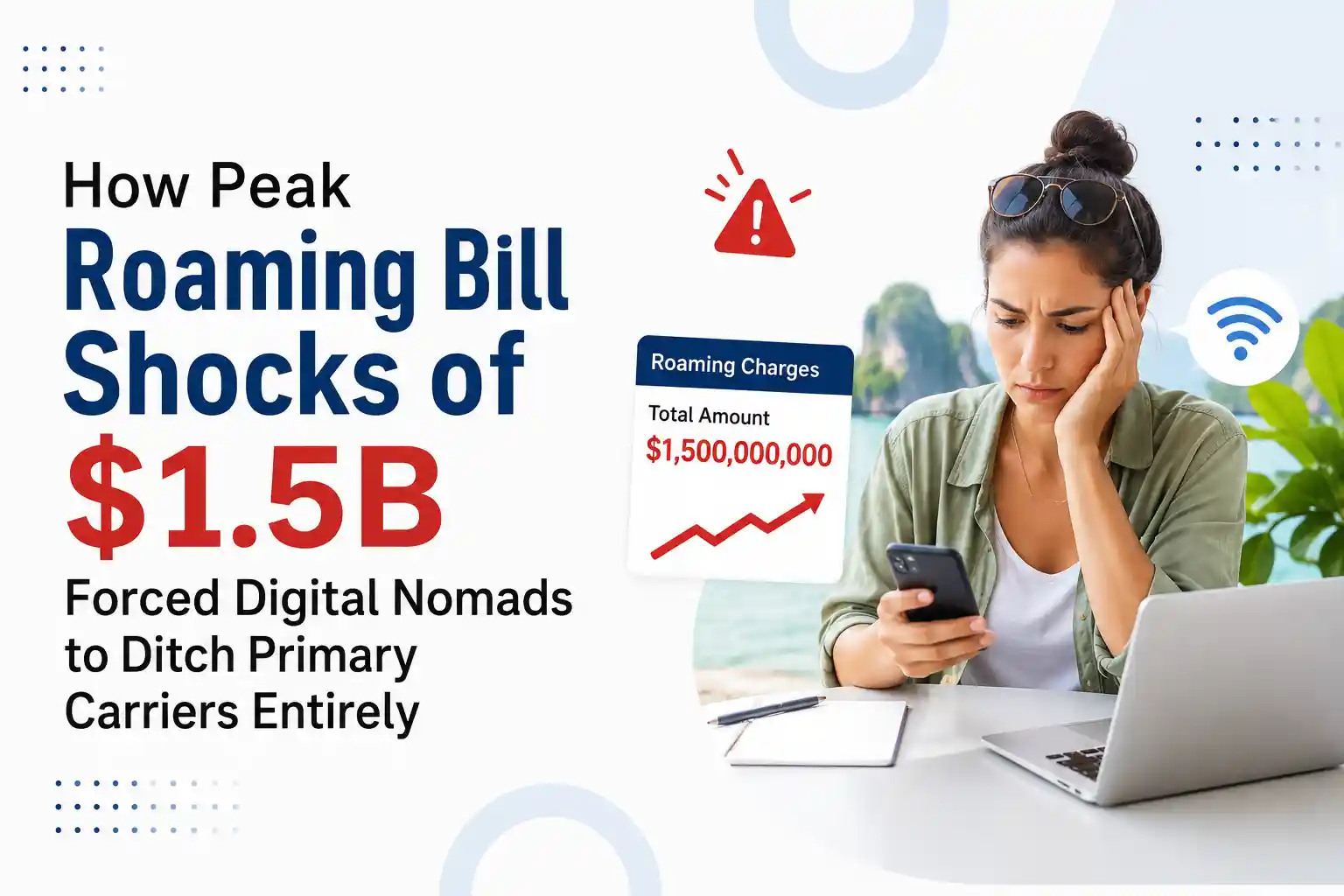
The turning point wasn’t a gradual shift. It was a collective realization sparked by a massive transfer of wealth. Between 2024 and 2025, as remote work solidified into a permanent lifestyle, legacy telecom carriers quietly extracted an estimated $1.5 billion in international roaming overages and daily pass fees from global travelers.
I experienced this firsthand in Lisbon. A forgotten setting on my phone allowed a 4GB background OS update to download over a cellular network while I slept. I woke up to a $1,200 bill.
This epidemic of “bill shock” fundamentally altered the digital nomad economy. It forced a mass exodus from primary carriers like AT&T, Verizon, and Vodafone, pushing remote workers toward a permanently decoupled, borderless connectivity stack.
Here is exactly how the telecom industry overplayed its hand and how you can permanently break free from your primary carrier.
The Anatomy of a $1.5B Global Bill Shock
Digital nomads experienced $1.5B in roaming shocks due to aggressive background data usage like cloud backups and AI syncing, triggering exorbitant per-megabyte international rates or automatic daily carrier passes without the user’s active consent.
To understand why this happened, you have to look at how smartphone behavior has evolved compared to telecom billing models.
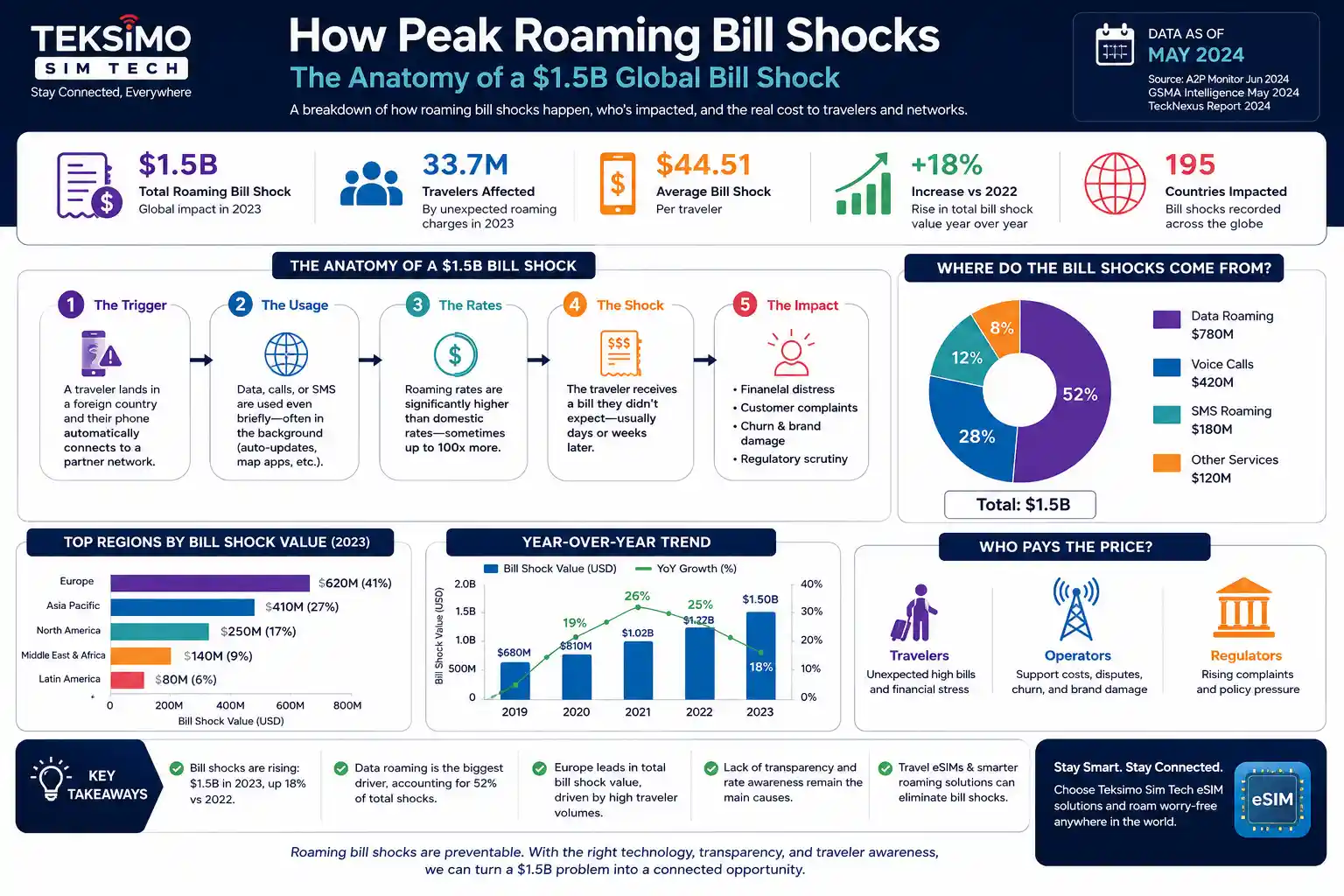
Legacy carriers rely on Wholesale Roaming Access (WRA) agreements. When you land in Thailand, your home carrier pays a Thai network wholesale pennies for your data. They then mark up that data by up to 4,000% when billing you.
The “Silent Sync” Trap of Modern Smartphones
Modern smartphones trigger roaming bills invisibly. Background app refresh, automated cloud photo backups, and AI-driven predictive fetching consume gigabytes of data while the phone is locked, resulting in massive roaming overages before the user ever opens a web browser.
Ten years ago, you only used data when actively loading a webpage. Today, your phone is a constantly breathing data engine. If you land in a foreign country and forget to toggle off data roaming, your phone immediately attempts to catch up on everything it missed during the flight.
A single 4K video backing up to the cloud can trigger hundreds of dollars in pay-as-you-go roaming rates in less than three minutes.
How Legacy Carriers Weaponized the $12 Daily Pass
Carriers weaponized daily international passes by making them opt-out rather than opt-in. A single background kilobyte of data, or an incoming spam text, automatically triggers a $10 to $12 daily fee, adding hundreds to a monthly bill.
Carriers marketed the “International Day Pass” as a consumer protection feature. Instead of charging you $2 per megabyte, they generously cap you at $10 to $12 a day.
The trap? These passes activate automatically. If your phone connects to a local tower to receive an unrequested 2FA text message from Uber, the carrier flags the day as “active.” For a digital nomad living abroad for three months, that “convenience” scales to nearly $1,000 in hidden fees.
Why the “Just Buy a Local SIM” Advice is Dead
The traditional advice of swapping physical local SIM cards is obsolete. It forces nomads to lose their home phone numbers, breaks two-factor authentication for banking, and creates a security vulnerability by tying critical accounts to temporary, recyclable phone numbers.
For years, the travel blog consensus was simple: arrive at the airport, find a kiosk, and buy a local physical SIM card.
This no longer works for a modern remote professional. When you swap your primary SIM, you instantly sever your connection to your home country’s banking ecosystem. You cannot receive SMS verification codes to log into your payroll software, authorize a wire transfer, or access your primary email. Furthermore, temporary local numbers are frequently recycled, meaning the next person who buys that SIM might gain access to your WhatsApp account.
The Decoupled Nomad Tech Stack
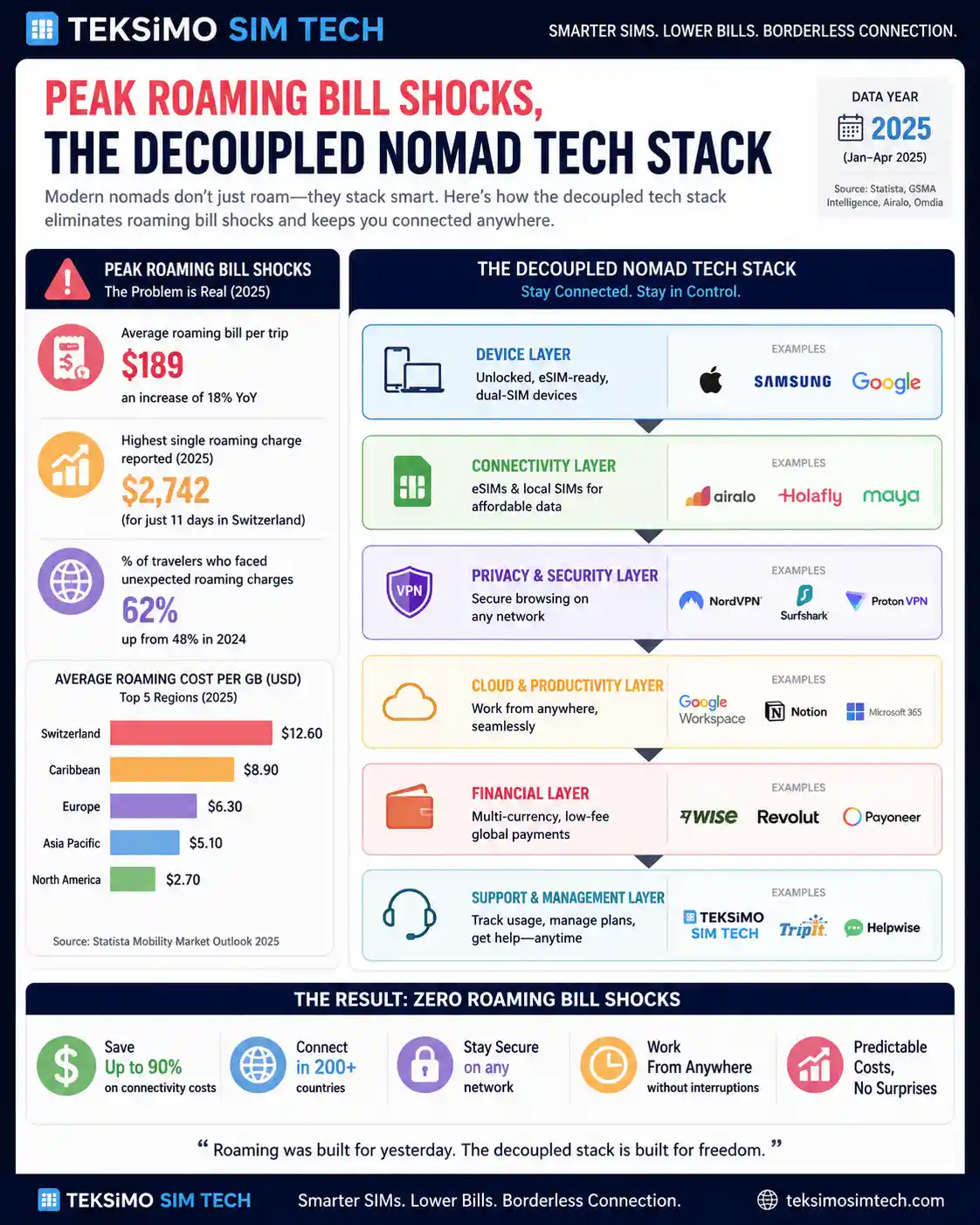
The Decoupled Nomad stack permanently separates a user’s phone number from their data provider. It uses a VoIP service for voice and SMS, combined with a rotating cast of regional eSIMs for wholesale data access, entirely bypassing legacy carrier roaming.
To achieve true carrier independence, nomads have stopped looking for “travel plans” from major telcos. Instead, they divide their connectivity into three distinct layers.
Layer 1: Global Data Aggregators (eSIM)
Global eSIM aggregators provide wholesale data access without requiring a physical SIM swap. Nomads download regional data profiles via QR code, paying local market rates directly and eliminating home-carrier roaming markups entirely.
Instead of paying a US or UK carrier for global access, you buy data directly from aggregators. Because modern phones support dual-eSIM standby, you can load a European regional eSIM that provides 50GB of data for $20, and switch to an Asian regional eSIM the moment your flight lands in Tokyo.
Layer 2: Cloud-Based Number Parking (VoIP)
Number parking involves porting a primary cell phone number to a cloud-based VoIP service like Google Voice, Skype, or OpenPhone. This allows nomads to make calls and receive texts over any Wi-Fi or eSIM data connection globally.
Your phone number should no longer be tied to a piece of plastic inside your device. By porting your long-standing phone number to a Voice over IP (VoIP) service, your number lives in the cloud. It routes calls and texts over the internet, utilizing the cheap data you bought in Layer 1.
Layer 3: The 2FA Banking Workaround
To solve the 2FA problem abroad, nomads port their number to a cheap, Wi-Fi calling-enabled domestic MVNO on a $5/month plan. By blocking cellular roaming entirely, the phone routes home-country SMS codes securely over the travel eSIM’s data connection.
Because some legacy banks refuse to send SMS codes to VoIP numbers, advanced nomads use a specific hybrid approach:
| Requirement | Solution | Monthly Cost |
| Banking SMS (2FA) | Ultra-cheap MVNO (e.g., Tello or Ultra Mobile) on Wi-Fi Calling | $5 – $10 |
| Daily Global Data | Regional eSIM (e.g., Nomad, Airalo, Saily) | $15 – $30 |
| Voice Routing | Device routes MVNO calls over the eSIM’s cellular data | $0 |
By turning off data roaming on the $5 home plan and turning on “Wi-Fi Calling,” your iPhone or Android will seamlessly use your travel eSIM’s data as a proxy Wi-Fi network. You receive your bank texts immediately, with zero daily carrier passes triggered.
Step-by-Step: How to Ditch Your Primary Carrier
- Verify your device is unlocked. Your phone must be fully paid off and network-unlocked. You cannot use travel eSIMs on a locked device.
- Purchase a cloud number or ultra-cheap MVNO. Set up an account with an MVNO like Tello ($5/mo) or a VoIP service.
- Initiate the Port-Out. Request a transfer PIN from your primary carrier (AT&T, Verizon, etc.) and port your number to the new service. Do not cancel your legacy plan first, or you will lose your number.
- Download an eSIM aggregator. Install an app like Airalo or Holafly before you travel.
- Configure Dual-Standby. Set your travel eSIM as the primary line for “Cellular Data,” and set your parked number as the primary line for “Voice & SMS.”
- Hard-disable data roaming. Go into your settings and toggle off “Data Roaming” strictly on your home number to prevent accidental leakage.
The Future of Borderless Connectivity
The $1.5 billion roaming wealth transfer was the catalyst for a much-needed evolution. Legacy carriers built their business models on geographical boundaries that no longer exist for the digital workforce.
As satellite-to-cellular connectivity becomes a reality in late 2026 and 2027, the concept of a “home carrier” will become increasingly archaic. By decoupling your phone number from your data source today, you aren’t just saving money, you are future-proofing your digital life against a telecom industry that still bills like it’s 2015.