

Stepping off a delayed flight at Dubai International, I pulled out my iPhone 15 Pro and swapped the physical tray for a tiny eSIM profile while the baggage carousel spun uselessly. Within two minutes, the device displayed a local number, a data plan, and a signal bar that refused to budge. The contrast with a second provider that lingered in “pending” for nearly twenty minutes was stark, and it forced a cascade of questions about the real cost of staying connected abroad.
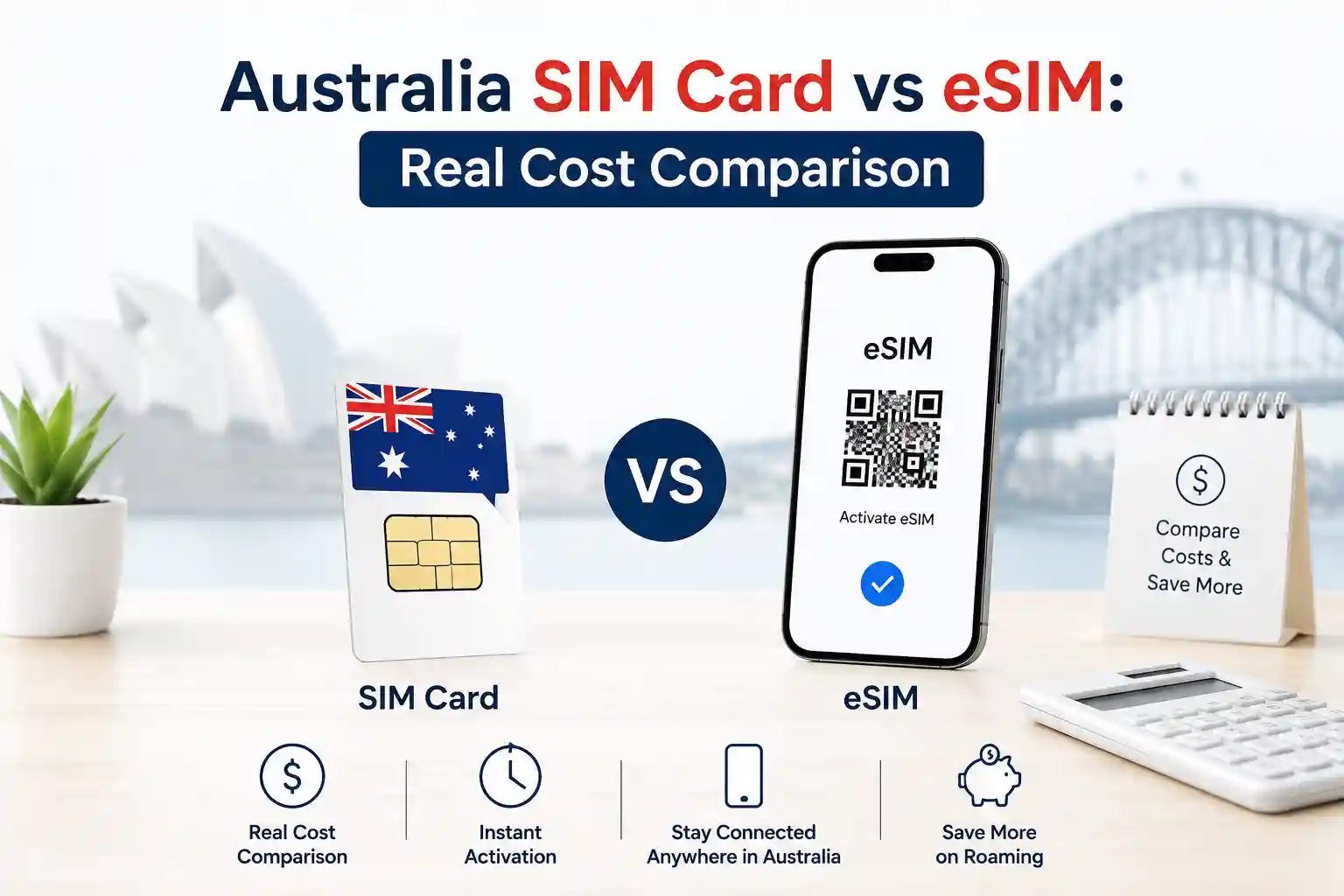
Discover how Australia SIM Card vs eSIM impacts your travel when you visit Australia.
Real‑World Scenario: Dubai Airport Test
Travelers often assume that a simple QR scan will instantly unlock data, but the reality is far more nuanced. In that cramped transit lounge, three variables collided: the device’s carrier lock status, the eSIM provisioning server’s response time, and the local network’s roaming agreement. The first provider succeeded because its backend had pre‑registered the device’s IMEI in a regional profile, allowing the QR code to resolve instantly. The second provider relied on a generic activation flow that required a round‑trip to a distant authentication center, introducing latency that turned a two‑minute expectation into a half‑hour frustration.
The Test Setup
I used an unlocked iPhone 15 Pro, a model that supports both physical SIM and eSIM profiles simultaneously. The device was set to “Automatic” carrier selection, and all APN settings were left at default. Two eSIM services — Airalo and a lesser‑known regional vendor — were loaded via QR codes supplied on the spot. For comparison, I also inserted a local physical SIM purchased at the airport kiosk, activating a 5‑day data bundle priced at AUD 30.
Device and Provider Details
The iPhone reported “T‑Mobile US” as the default carrier, a legacy setting from a previous US trip. Despite the phone’s global readiness, the eSIM activation sequence depended on the carrier profile stored on the device. Airalo’s profile was pre‑configured for “Australia – 5 GB” and triggered a direct push from the provider’s activation server located in Singapore. The other vendor’s profile required a fallback to a European server, adding an extra hop that manifested as the 20‑minute stall.
Technical Foundations of SIM Activation
At its core, an eSIM is a programmable SIM that resides in the device’s firmware. When a QR code is scanned, the phone reads a profile identifier and contacts the carrier’s provisioning server to download a carrier profile. This process is governed by the GSMA RSP (Remote SIM Provisioning) specification, which dictates how the profile is transferred, validated, and stored.
Physical SIM vs eSIM Provisioning
Physical SIMs require a physical slot and a carrier‑specific SIM card. Activation typically involves inserting the card and waiting for the network to recognize the SIM’s ICCID. eSIMs eliminate the hardware step but introduce a software dependency: the device must trust the carrier’s provisioning endpoint and be able to download the profile over HTTPS. If the device’s trust store does not include the carrier’s certificate — common with newer MVNOs — activation can stall.
APN Configuration
Once the profile is installed, the device must be told how to route traffic. The Access Point Name (APN) is the gateway that translates a data request into a carrier‑specific identifier. Misconfigured APNs are a frequent source of “no data” errors after activation, especially on devices that have previously stored legacy APN settings from a different region. Resetting the network settings or toggling airplane mode forces the device to re‑query the carrier’s latest APN list, often clearing the mismatch.
Cost Mechanics Behind Australia SIM Card vs eSIM
Pricing for Australian mobile connectivity hinges on three distinct layers: the base data allotment, the carrier’s markup, and the roaming surcharge applied when the device connects to a foreign network. Physical SIMs are often bundled with a prepaid plan that includes a fixed data amount, a set number of local minutes, and a per‑minute overage fee. eSIMs, by contrast, are sold as data‑only bundles that can be layered on top of an existing plan or used as a standalone solution.
Carrier Pricing Models
Major Australian carriers — Telstra, Optus, and Vodafone — price their prepaid data packs based on volume tiers: 2 GB, 5 GB, 10 GB, and so on. The per‑megabyte cost drops dramatically as the tier increases, reflecting economies of scale in wholesale bandwidth. MVNOs that resell capacity from these carriers typically add a 10‑15 % margin, which is reflected in higher per‑GB rates for small bundles.
Roaming Charges
When a device connects to a foreign network, the visited carrier charges the home carrier a wholesale rate for each megabyte of data consumed. The home carrier then translates that cost into a consumer fee, often adding a markup of 30‑50 % to cover administrative overhead. This layered pricing explains why a “$10 eSIM plan” can feel expensive once roaming fees are applied, especially if the plan is activated while still registered on a domestic network.
What Most eSIM Articles Miss About the Australian SIM Card vs eSIM
Many guides focus on headline price comparisons, but they gloss over the hidden mechanics that can inflate the final bill. One overlooked detail is the “activation window” — the period during which the carrier’s provisioning server expects a successful handshake. If the device loses connectivity during that window, the profile may remain in a “pending” state, forcing the user to delete and re‑install the eSIM, a process that can consume both time and data.
Hidden Fees
Beyond the advertised data price, some providers embed a “service fee” that ranges from AUD 1 to AUD 3 per activation. This fee is often buried in the fine print and is charged regardless of whether the eSIM is eventually used. Additionally, certain carriers impose a “re‑provisioning fee” if the user switches between multiple eSIM profiles within a short timeframe, a cost that can accumulate for frequent travelers who rotate plans.
Activation Delays
Activation delays are not merely a nuisance; they can trigger secondary charges. If a device fails to register on the visited network within a predefined timeout, some operators automatically switch the device to a higher‑priced roaming tier, applying a per‑minute roaming surcharge even before any data is consumed. Recognizing this latency helps users decide whether to rely on eSIM provisioning or fall back to a physical SIM purchased on arrival.
Practical Takeaways
Decision‑making in the Australian travel connectivity space benefits from a concrete checklist that aligns technical capability with budget constraints.
Decision Checklist
1. Verify that your device supports dual‑SIM operation and that the carrier profile is unlocked for international use.
2. Confirm the eSIM provider’s activation server location; providers with regional servers in Asia‑Pacific typically offer faster handshakes for Australian travelers.
3. Compare the total cost of a prepaid physical SIM bundle against the advertised eSIM price, adding any potential service or re‑provisioning fees.
4. Test the APN settings immediately after activation; a quick toggle of airplane mode can validate that the profile has correctly registered with the local network.
5. Keep a backup physical SIM on hand for scenarios where eSIM provisioning fails, especially in airports with spotty Wi‑Fi.
Human Failure Insight
At first glance, the setup process appears simple: just scan a QR code, and you’re online. Yet as soon as carrier provisioning and regional network compatibility enter the picture, the process becomes less predictable, and a single missed step can cascade into unexpected fees or lost connectivity.
Frequently Asked Questions
Q: Can I use the same eSIM profile on multiple devices?
A: No. eSIM profiles are tied to the device’s IMEI. Transferring a profile requires deletion from the original device and re‑provisioning on the new one, which may incur additional activation fees.
Q: Do I need to pay extra for data used while roaming on an eSIM?
A: Yes. Even if the eSIM plan advertises “unlimited data,” the roaming agreement often caps speeds or applies a separate roaming surcharge once the device connects to a foreign network.
Q: How long does an eSIM activation typically take?
A: In optimal conditions, activation completes within 30‑60 seconds. Latency can increase to several minutes if the provisioning server is located far from the visited network or if the device’s network stack is congested.
Q: Is a physical SIM ever cheaper than an eSIM for short trips?
A: For trips under three days, a prepaid physical SIM purchased at the airport often offers.