
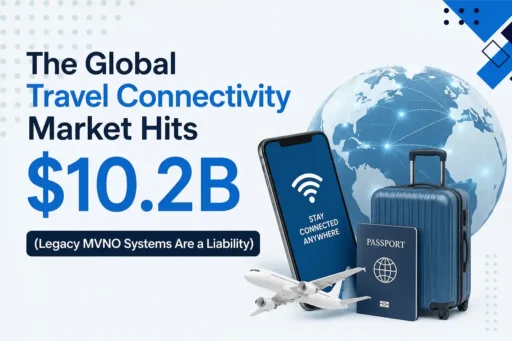

The Global Travel Connectivity Market Hits $10.2B (Legacy MVNO Systems Are a Liability)
International travelers no longer wait in line at airport kiosks to buy physical SIM cards. They purchase data plans directly from their hotel apps, airline checkout flows, or digital aggregators weeks before they pack their bags.
This behavioral shift has radically transformed telecom economics. The travel connectivity market has violently pivoted away from physical logistics toward software-defined networking, leaving operators reliant on outdated infrastructure scrambling to compete.
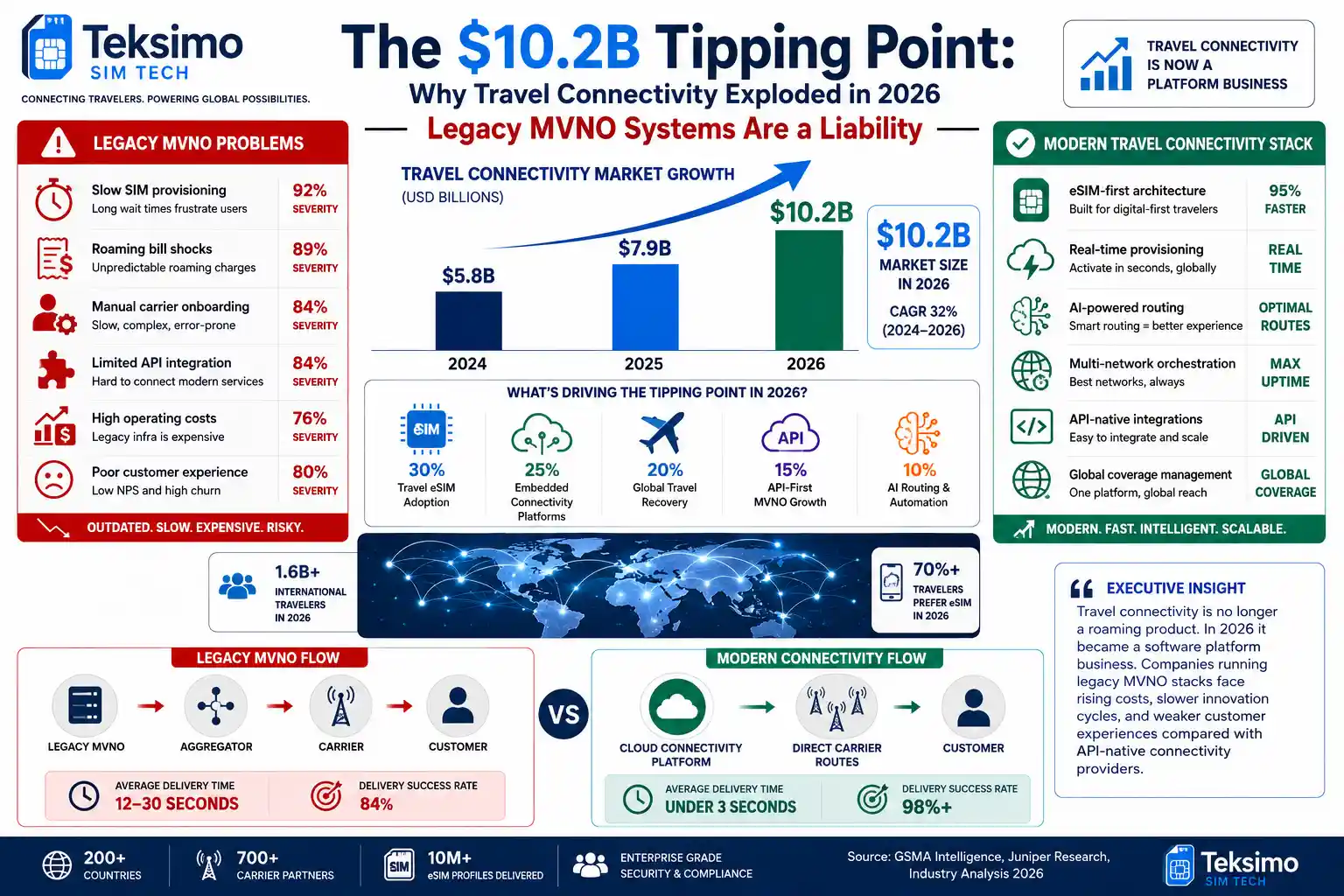
The $10.2B Tipping Point: Why Travel Connectivity Exploded in 2026
The global travel connectivity market reached $10.2 billion in 2026, driven by the mass adoption of eSIM-capable smartphones and a fundamental shift toward pre-arrival digital purchasing. Travelers now expect seamless, instant network access, abandoning traditional physical SIMs and expensive carrier roaming plans in favor of agile, app-based connectivity solutions.
By 2030, analysts project that over 82% of international trips will include a pre-arrival roaming purchase. The friction of store visits, paper contracts, and two-day activations has been replaced by the demand for instant, on-demand access to global networks.
Device manufacturers forced this hand. With Apple and Samsung enforcing eSIM-only design philosophies across flagship and mid-tier ranges globally, the physical SIM slot is rapidly becoming a relic.
The Rise of Silent Roaming and eSIM Dominance
Silent roaming is the automatic, frictionless transition to local network connectivity profiles as travelers cross borders, powered by eSIM technology. This digital-first approach eliminates physical kiosks and manual setup, allowing aggregators and modern telcos to capture users before they even board their flights.
Consumers treat connectivity as a disposable utility. They use their home voice number as a persistent identity but aggressively shop around for the best localized data rates. Digital MVNOs (Mobile Virtual Network Operators) capitalize on this price sensitivity.
By utilizing dynamic multi-IMSI routing, modern eSIM platforms connect users to the strongest local network without incurring traditional cross-border roaming fees. Travelers routinely save up to 35% per gigabyte compared to standard carrier plans, effectively killing the “bill shock” business model.
Why Legacy MVNO Systems Are Now a Toxic Liability
Legacy MVNO systems are a liability because they rely on monolithic billing architectures, manual provisioning processes, and outdated signaling that create severe API latency. These technical debts prevent operators from offering the instant, on-demand digital experiences modern travelers require, resulting in massive customer churn to agile competitors.
Many MVNOs still operate on an architecture built for the 3G and 4G eras. Their Business Support Systems (BSS) and Operational Support Systems (OSS) are tightly coupled. When a customer buys a data plan, the transaction must pass through layers of aging databases before the network actually provisions the service.
This latency is fatal in a digital-first market. If an eSIM profile takes five minutes to generate instead of five seconds, the modern consumer will cancel the transaction and download a competitor’s app.
The API Friction and OTA Integration Problem
Over-the-air (OTA) integration fails in legacy MVNOs due to rigid, hard-coded network interfaces that cannot rapidly communicate with modern travel apps or fintech platforms. Without robust API gateways, legacy providers cannot embed their connectivity services into third-party checkout flows, locking them out of vital distribution channels.
Connectivity is no longer sold strictly through telecom channels. It is embedded directly into digital wallets, airline booking confirmations, and corporate travel portals. This is the Embedded Telco model.
Legacy systems cannot support this level of distribution. They lack the lightweight, RESTful APIs required to let a third-party application trigger network provisioning. Every new partnership requires months of custom coding, whereas a cloud-native competitor can issue an API key and launch a partnership in an afternoon.
Cloud-Native eSIM Architectures: The New Standard
Cloud-native eSIM architectures operate on decentralized, API-driven frameworks that decouple business support systems from network operations. This modern standard enables zero-touch activation, multi-IMSI routing, and seamless integration with third-party digital ecosystems, allowing telecom providers to launch branded travel data plans instantly.
Agile platforms treat network profiles as software goods. They utilize cloud-based Remote SIM Provisioning (RSP) engines to push data profiles directly to device secure elements over standard Wi-Fi.
This architecture drastically reduces operating expenses. It eliminates SIM manufacturing, packaging, warehousing, and shipping costs. Those margins are then reinvested into aggressive pricing and hyper-localized marketing campaigns.
Amdocs and Sineli: 2026’s Success Blueprints
In 2026, companies like Amdocs and Sineli Telecoms proved the value of modern telecom architecture. Amdocs launched its eSIM Traveler Solution to give legacy carriers zero-touch activation, while Sineli captured significant market share by offering enterprise-grade, digital-first travel connectivity without the burden of legacy infrastructure.
Amdocs specifically designed its eSIM Cloud to stop the bleeding of traditional roaming revenues. By enabling legacy Communication Service Providers (CSPs) to offer instant, branded data plans through their existing apps, they bypass third-party aggregators completely.
Meanwhile, nimble startups like Sineli recognized that corporate travel teams despise unpredictable roaming costs. They targeted the enterprise segment directly, providing API-driven connectivity platforms that integrate seamlessly with corporate expense management software—a feat mathematically impossible for a legacy MVNO burdened by monolithic billing.
How Telecoms Must Pivot to Survive
To survive the $10.2B connectivity shift, telecom operators must abandon legacy monolithic structures and aggressively migrate to cloud-based entitlement servers and unified data management. Upgrading to a digital-first Remote SIM Provisioning (RSP) engine is the only way to deliver the instant experiences international travelers demand.
The threat is existential. Operators who fail to modernize will watch their high-margin roaming revenues evaporate as customers silently switch to third-party aggregators the moment their plane touches down.
The 3-Step MVNO Modernization Playbook
The roadmap for MVNO modernization requires a phased technical decoupling. Operators must first separate billing from the operational core, deploy a cloud-native entitlement server to communicate directly with device manufacturers, and finally implement digital Remote SIM Provisioning to replace physical logistics with over-the-air activations.
Attempting to upgrade everything at once usually results in catastrophic network failure. Migration requires strict architectural discipline.
Legacy MVNOs have a distinct advantage: they already possess the wholesale MNO relationships and the customer bases. If they can shed their technical debt and adopt cloud-native provisioning, they can easily reclaim the travel connectivity market. If they don’t, the aggregators will take it all.